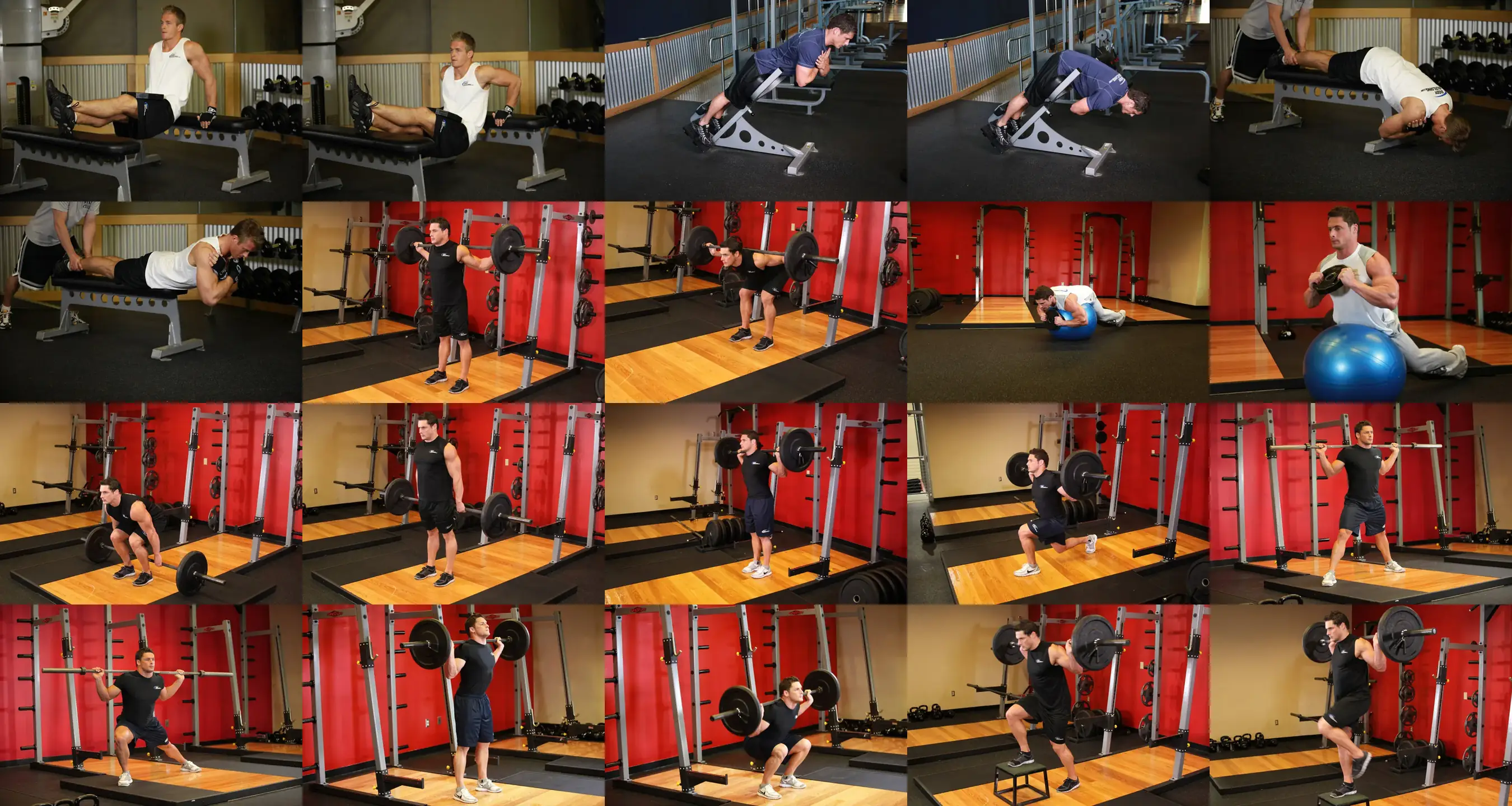
Setup and loading
Place the ball under your hips and lower stomach, with the balls of your feet pressed into the base of a wall. Master 15 unweighted reps first, then hold a light plate against your chest.
How to do the weighted stability ball back extension step by step
- Lie face down on the ball with your hips and lower stomach supported and your legs straight.
- Press the balls of your feet into the base of a wall, hip width apart.
- Hold a plate or dumbbell against your chest with both arms and let your torso curl over the ball.
- Exhale and extend your back and hips until your body forms a straight line from head to heels.
- Squeeze your glutes and mid back for a second at the top with your shoulders pulled back.
- Inhale and lower slowly, letting your torso wrap back around the ball.
Form cues
- Feet planted firmly against the wall
- Weight tight to your chest, no swinging
- Rise to a straight line
- Lower slowly around the ball
Common mistakes
- Jerking up: the ball rolls and you lose control; use a slow tempo.
- Overarching at the top: it compresses your lower back; stop at a straight line.
- Ball in the wrong spot: under your chest it shortens the range; set it under your hips.
- Adding weight too soon: stability breaks down; own the unweighted version first.
How to make it easier or harder
To make it easier, do it without weight, hands behind your head or crossed. To progress, use a heavier plate, hold the weight with arms extended forward, or move to a weighted hyperextension bench.
Sets and reps for your goal
Hypertrophy
3-4 x 8-12 · rest 60-90 s3-4 sets of 6-12 reps (up to 15-20 on isolation exercises) at 65-80% of your max. Rest 1 to 2 minutes.
Get close to failure (0-3 reps in reserve) and control the lowering for 2-3 seconds. Accumulate 10-20 sets per muscle per week.
Max Strength
4-5 x 3-6 · rest 2-3 min3-6 sets of 1-6 reps at 80-90% of your max (1RM). Rest 2 to 5 minutes.
Leave 1-3 reps in reserve. If your technique breaks down, lower the weight: strength is built with good reps.
A guide for healthy adults. Adjust the load to your level and see a professional if you have an injury.
Check your form
Film yourself from the side or ask someone to watch, then tick what you get right.
Frequently asked questions
What are stability ball back extensions good for?
They strengthen your lower back, glutes, and hamstrings through a long range while adding some stability work. They are a solid alternative to a hyperextension bench if you train at home or want variety.
Where do I put my feet for ball back extensions?
The most stable setup is pressing the balls of your feet against the base of a wall or under sturdy furniture. Placing them hip width apart or slightly wider improves your balance on the ball.
Sports it suits
Gear for this exercise
- Stability ballPick the diameter for your height (55-65 cm for most people).
As an Amazon Associate, Muscle Atlas earns from qualifying purchases.